Articles
One Europe, two startup realities. Can EU Inc. bridge the impact innovation gap between Eastern and Western Europe?
November 4, 2026 · Oana Cosman
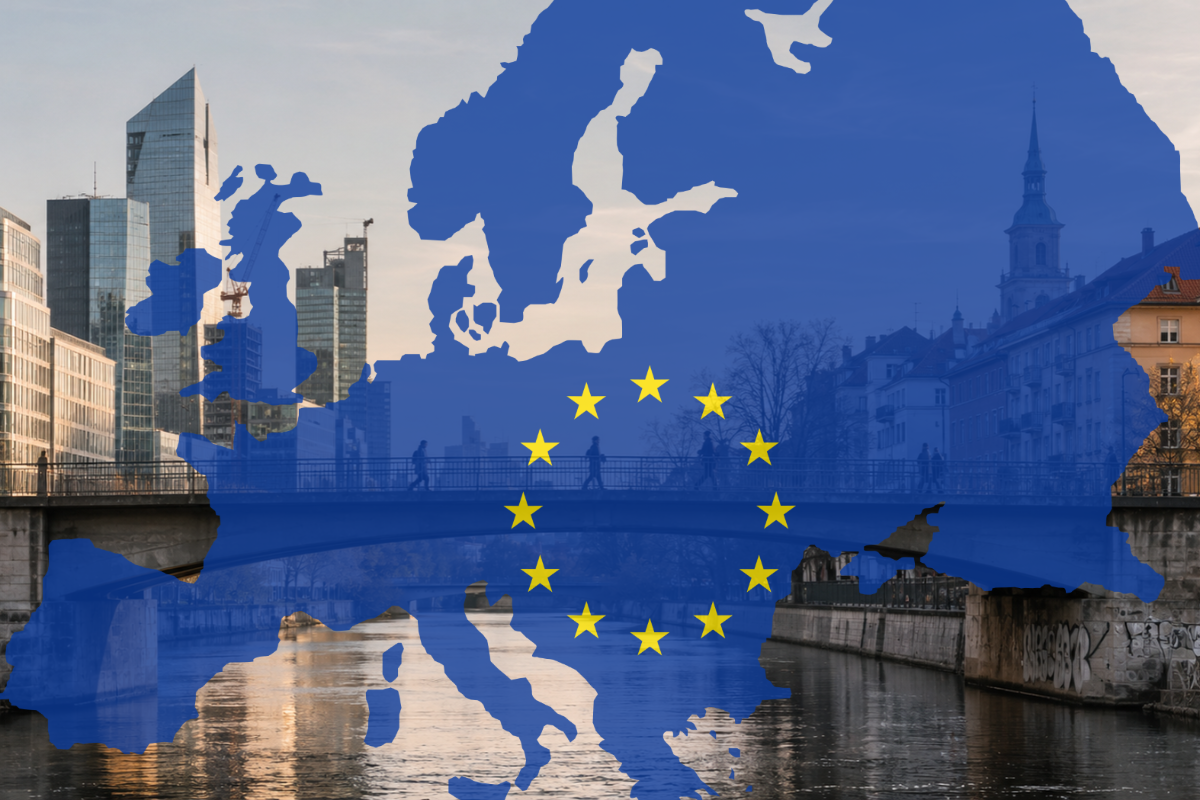
Europe wants to become a global leader in sustainable innovation. Across the continent, startups are developing technologies to reduce industrial emissions, improve healthcare, accelerate renewable energy adoption and build more circular economies.
A founder building a climate-tech company in Bucharest or Sofia does not necessarily have the same opportunities as one based in Paris, Berlin or Amsterdam. Or have the same models for inspiration.
I am thinking now of an interview I had for Green Start-Up 2 years ago with Tom Meijeraan, the founder of Arctic Reflections, a startup that took up the mission to regenerate Arctic sea ice in order to slow down global warming. Tom was telling me that the idea was derived from a technique the Dutch ‘ijsmeesters’ use to thicken the ice of ice-skating rinks on natural ice: applying small layers of water on the ice when temperatures are well below zero, so that the ice thickens quickly, allowing the skating rink to be used sooner. The technique is also used in Canada and Scandinavia to create ice roads.
Anyway, coming back to the point of our article, impact founders from any corner of Europe may develop equally promising technologies. But access to venture capital, specialised investors, research partnerships, customers and international networks remains uneven.
Europe has a single market, but it does not yet offer a single startup ecosystem and that’s a huge pain point for everybody.
For impact founders, whose businesses often require patient capital, industrial partnerships and cross-border adoption, that fragmentation can determine whether a solution reaches the market at all.
The East-West divide is about opportunity, not talent
In 2018, entrepreneur Asparuh Koev described the differences between Eastern and Western European startups in an article for Entrepreneur.
According to him, Western founders generally had greater access to venture capital and could raise money around a long-term vision. On the other hand, Eastern European entrepreneurs often needed to demonstrate a working product and commercial viability earlier.
Eight years later, Europe's startup ecosystem has changed substantially, but the financing imbalance is still there.
According to Dealroom's Central and Eastern European Startups 2025 in Review, CEE startups raised 2.3 billion euros in venture capital in 2025. Their combined ecosystem value reached 274 billion euros in 2026.
The region is also demonstrating capital efficiency. Dealroom estimates that CEE generates 120% of the European average in enterprise value per euro of venture capital raised, despite receiving only 40% of the European average VC funding relative to GDP.
Yet the biggest funding challenge appears as companies grow. CEE investors accounted for 90% of the ten most active pre-seed and seed investors in the region between 2021 and 2026, but only 10% of the most active investors at Series B and beyond.
For ambitious founders, international capital is often not optional. It becomes essential.
Why fragmentation matters more for impact startups
Impact startups face many of the same challenges as conventional technology companies, but their business models can make those barriers more difficult to overcome.
A software startup may expand internationally with a relatively small team and limited physical infrastructure. A company developing battery technology, sustainable materials, medical devices or industrial decarbonisation solutions may need laboratories, manufacturing facilities, regulatory approvals, pilot customers and substantial investment before generating meaningful revenue.
In a report from 2024 called Beyond Fragmentation, the European Commission identifies regulatory differences, unequal funding access, talent mobility and the concentration of accelerators and support networks in established hubs as obstacles to European startup growth.
These barriers are especially consequential for companies attempting to commercialise sustainability technologies.
And the problem extends beyond Eastern Europe. An analysis published at the beginning of this year by EU.VC, by the World Fund, estimates that European climate tech startups faced a cumulative 13.5 billion dollars Series B funding shortfall compared with their US counterparts between 2020 and 2024. European Series B rounds averaged approximately 20% less than equivalent US rounds.
If even established Western European climate tech ecosystems struggle to finance commercialisation, the challenge can be greater for founders operating outside the continent's main investment networks.
Different ecosystems, different advantages
The divide should not be interpreted as Western Europe having better entrepreneurs or Eastern Europe producing less valuable innovation. The two regions have different strengths.
Western European hubs generally offer more developed venture networks, specialised climate and impact funds, corporate partnerships and experienced scale-up executives.
CEE ecosystems can offer competitive development costs, strong engineering capabilities and founders accustomed to building companies with limited resources. Smaller domestic markets can also encourage international expansion early in a company's development. These characteristics can be complementary.
Let’s imagine that out there there’s a Romanian startup developing software that reduces energy consumption in industrial facilities. Its tech team might remain in Romania, while its first major customers could be manufacturers in Germany or France. It could seek specialist climate tech investors in Western Europe and use European research or innovation programmes to support further development.
The opportunity is not necessarily to move the entire business to the West, but to connect Eastern European innovation with customers, capital and expertise across Europe.
EU Inc.: one possible answer to fragmentation
This is where the proposed EU Inc. framework becomes particularly relevant. In March 2026, the European Commission introduced EU Inc., an optional pan-European corporate legal regime intended to simplify the creation and operation of companies across the EU.
The proposal would allow founders to register companies digitally within 48 hours, for a maximum of €100, using harmonised corporate rules. It also aims to simplify share transfers, financing operations and employee stock-option arrangements.
On October 23, 2026, the Council adopted its negotiating position, advancing the proposal through the legislative process. EU Inc. is not yet an operational legal regime.
For impact founders, the potential benefits become very practical.
A Bulgarian circular economy startup seeking French investors, or a Romanian climate tech company expanding into Germany, could eventually operate within a more familiar corporate framework for cross-border investment.
Simpler incorporation, equity financing and employee ownership could reduce some of the legal and administrative friction associated with scaling internationally.
However, EU Inc. will not automatically create equal access to capital. That’s not its purpose. A common corporate structure cannot replace specialised investors, industrial customers, research infrastructure or experienced teams. Nor does it remove every difference in national taxation, employment law or sector-specific regulation.
It addresses one part of fragmentation, not the entire problem.
What would a connected impact ecosystem look like
The European Commission's Startup and Scaleup Strategy acknowledges that fragmented markets, uneven financing, limited risk appetite and difficulties commercialising research continue to restrict European innovation.
For impact founders, overcoming these barriers means stronger cross-border investment networks connecting CEE startups with Western European impact and climate funds. It means easier access to corporate pilot projects, research facilities and customers across national borders. It also means combining venture capital with grants, public funding and other financing instruments suited to technologies that require longer development cycles.
Keep in mind that a connected ecosystem shouldn't require every successful Eastern European startup to relocate its headquarters.
According to Dealroom's 2025 CEE report, 48% of the region's scaleups had moved their headquarters outside their country of origin. This illustrates how frequently international expansion is accompanied by corporate relocation.
Europe's challenge is to make cross-border growth possible without making relocation a criteria for accessing opportunity.
From two startup realities to one European opportunity
The East-West divide is not simply a question of where venture capital is concentrated. It is also about where innovation can be developed, financed, commercialised and, ultimately, scaled.
For sustainability and impact startups, that distinction matters because environmental and social challenges do not respect national borders.
A technology developed in Warsaw may help decarbonise manufacturing in France. A Romanian health-tech startup may address a problem shared by hospitals across Europe. A circular economy solution developed in Sofia may find its largest market in Germany. EU Inc. could remove some barriers, but the larger opportunity lies in connecting Europe's different entrepreneurial strengths.
The goal shouldn’t be to make Eastern European impact startups look like Western European startups (anyway, it's a very difficult, if not impossible task). It should be to ensure that a promising solution has comparable opportunities to succeed, regardless of where its founders started.
That’s because Europe's sustainability transition will depend not only on how much innovation it produces, but also on how effectively it allows that innovation to go beyond borders, attract capital and reach markets where it can truly make a difference.